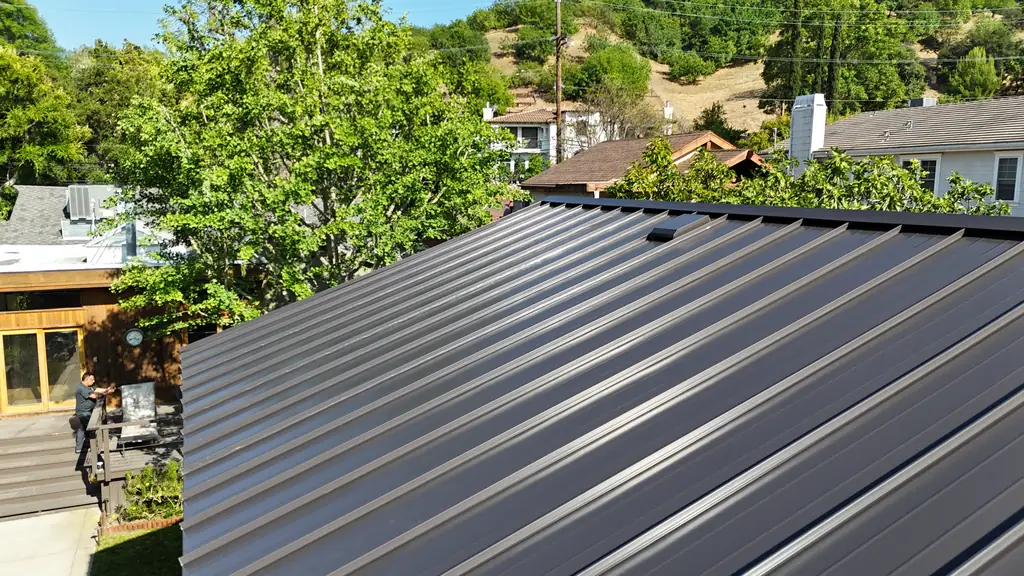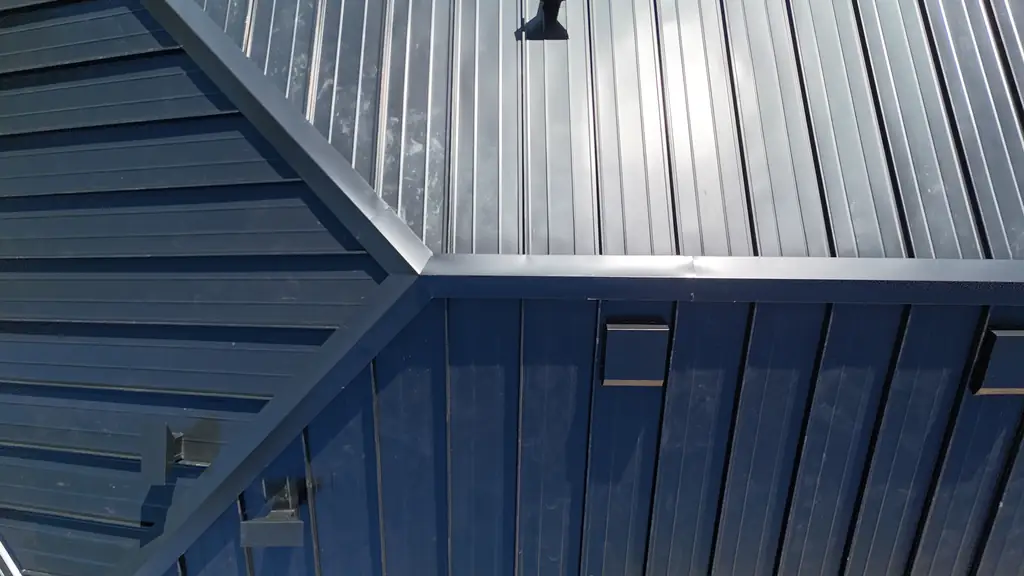
Start with the license, before anything else
In California, a roofing contractor needs a license from the Contractors State License Board (CSLB). Checking it takes a minute. Go to the CSLB license lookup, enter the license number from the contractor's estimate or truck, and look at four things:
- Status. It should read active.
- Classifications. C-39 is roofing. C-43 is sheet metal. A standing seam contractor should hold C-39, and C-43 is a good sign for shop and flashing work.
- Bond. A contractor's bond should be listed.
- Workers' compensation. If the company has employees on your roof, there should be a policy on file.
Also check that the business name on the license matches the name on the estimate and the contract. Ours is Eclipse Remodeling & Roofing Inc, license #888710, operating as Eclipse Metal Roofing.
Ten questions to ask a standing seam contractor
1. Who will actually install my roof?
Listen for names and a clear answer: "our own crew." If the company sells the job and passes it to a subcontractor, you are relying on people you never vetted. Ask whether the installer is licensed and insured, and who you call if something goes wrong.
2. Who forms the panels?
Standing seam panels are either formed by the contractor on its own roll former or bought from a supplier, cut to ordered lengths. Both can produce a good roof. A contractor who forms its own can match panel lengths to each run and form a replacement panel the same day if one is damaged. Ask which you are getting.
3. Will long slopes be covered by single panels?
One of the strengths of standing seam is panels that run unbroken from eave to ridge. Ask how the longest runs on your roof will be handled, and whether any end laps are planned.
4. Which panel profile, and why?
Mechanically seamed and snap-lock panels behave differently on low slopes and in wind. Panel width, rib height and whether the pan has striations also change the look. A good contractor explains the choice for your roof instead of offering one profile for every house.
5. What metal, what thickness and what finish?
Ask for the metal (steel or aluminum), the gauge and the paint system by name. Then ask what the finish warranty covers and what conditions apply, such as distance from salt water. Get it in writing.
6. What goes under the panels?
Underlayment matters as much as the metal. Ask which product, whether it is rated for the heat a metal roof sees, and how it is lapped at valleys and edges.
7. How will you flash my chimney, skylights and walls?
Most leaks on any roof start at a transition. A standing seam contractor should explain how each detail on your roof will be flashed, and whether the flashings are bent to fit on the job.
8. What happens if you find bad decking?
Tear-off sometimes reveals damaged sheathing. Ask how it is handled, how you will be told, and how the cost is set before the work is done.
9. Who pulls the permit and meets the inspector?
In most cases a reroof needs a building permit. The contractor normally pulls it. Make sure the scope says so.
10. What does the warranty cover, and who stands behind it?
There are usually two warranties: the manufacturer's on the material and finish, and the contractor's on the workmanship. Ask for both in writing and read what they exclude.
How to read a written scope
A scope is the contractor's promise in writing. A good one for a standing seam roof should name, at a minimum:
| Item | What it should say |
|---|---|
| Tear-off | What comes off, down to which layer, and how debris is hauled away |
| Deck | How damaged decking is found, priced and approved |
| Underlayment | The product by name |
| Panels | Profile, metal, gauge, finish and color |
| Flashings and trim | Which details get new flashings, and in what metal |
| Permit | Who pulls it and who pays the fee |
| Warranty | Material and workmanship, with the documents attached |
If two estimates differ a lot in price, the scope usually explains why. One may include a full tear-off and new underlayment while the other assumes a layover, or one may use a heavier metal.
Warning signs
- A firm price given without anyone seeing the roof.
- Pressure to sign the same day.
- A license number that does not match the company name, or no license number at all.
- Vague answers about who installs the roof.
- No written scope, or a scope that just says "metal roof."
Ask us the same questions
We wrote this guide so you can hold every contractor to the same standard, including us. Our crew installs every roof we sell, we form our panels on our own roll former, and our license is public. Call (424) 404-8671 and ask away, or read how we work as a standing seam contractor in Los Angeles.